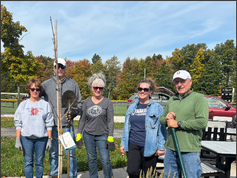






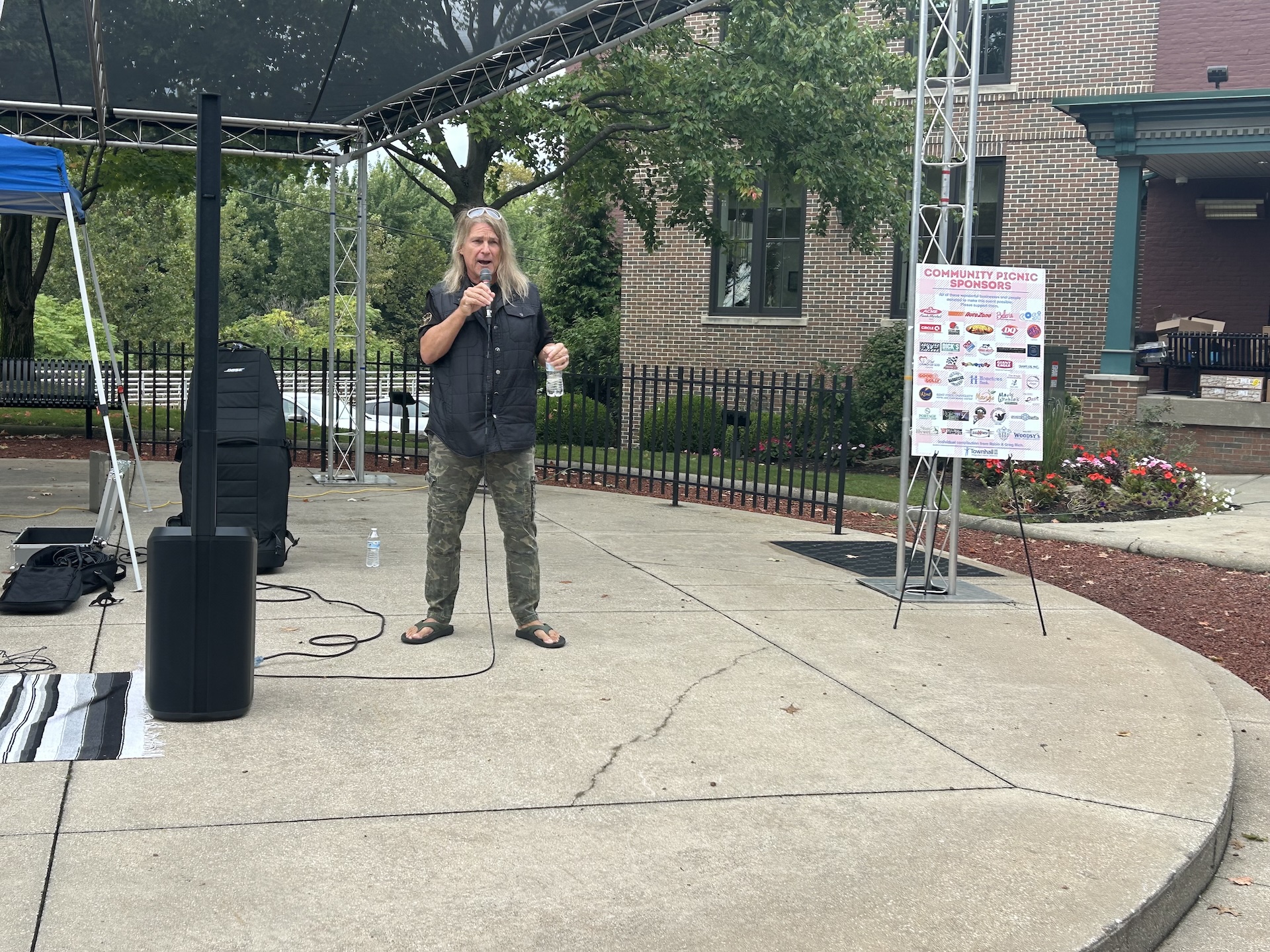
It took more than some chilly weather and overcast skies to prevent Townhall II Integrated Health Services hosting its annual community picnic last Saturday afternoon at Hometown Bank Plaza in downtown Kent.
The annual event included a raffle basket auction where all of the funds raised were donated to Townhall II, the handing out of cards allowing people to receive a free ice cream cone at Good Golly Ice Cream Shop, a petting zoo courtesy of Pure Passions Farm and a live musical performance by musician/writer Marc Lee Shannon, former lead guitarist of the Michael Stanley Band.
“I feel like Marc is a Townhall II employee,” Townhall II Chief Executive Officer Tamera Hunter told the audience. “He is a fixture for us.”
Shannon performed an hour-long set of musical numbers while taking the audience on a journey chronicling his battle against addiction.
According to Shannon, the day marked 11 years, 10 months and 11 days of sobriety for him, which had been part of a 28-year battle of recovery. He acknowledged his recovery was not a straight line.
“If you had told me that I’d be standing here, I would have bet against you,” he remarked.
Shannon compared his recovery to that of a man whose car was in disrepair and needed to be fixed. No matter how much he said he could fix the problem, he had problems living up to his responsibilities such as being on time for work or picking up his children from school. Soon, everyone in his life realized that they could not rely on him.
According to Shannon, his problems started at a young age when he developed trust problems with his own family, where there was chaos and conflict in his household ultimately leading to his parents’ divorce.
He added that as he became a teenager, he spent most of his free time with a dangerous crowd, usually passing the time at the local McDonald’s. He recalled that the group he was a part of invited him to get high one day.
Shannon said that abuse problems worsened when after he became a recreational drug user, he started drinking, beginning with his Dad’s whiskey. He said that he learned three things after the first time he drank, what alcohol tasted like going down, what it tasted like coming up and what it felt like waking up on the bathroom floor.
He noted that in his battle against addiction, he learned that the first stage of addiction was that it was the primary problem, the second was that it was chronic so unless he received treatment, things would not get better and the third stage was that of addiction could be fatal, as Shannon’s addiction landed him in the ICU three separate times.
Shannon said that his musical journey started in high school, as he wanted to be a musician and athlete, but found that he had a talent for music when he submitted a song that he wrote to a scholastic contest and was named the winner. After his senior year, he moved to California and became a studio musician.
During his time in California, Shannon acknowledged that his addiction worsened when he discovered cocaine,
“First I found out I couldn’t control how much I did, how much I spent on it, who I did it with and where I did it,” Shannon said.
He noted that his addiction reached a point where his friend who often supplied him with drugs trusted him with his apartment keys while he was away and he staged a robbery to find more drugs.
He said that is when he knew he had a problem but still was not ready to get treatment but did move back to Ohio. He added he remembered each time that he wound up in the ICU.
Shannon said that his addiction reached a point that it was almost as if he was driving that same car on the road and it broke down in the middle of traffic. Shannon said that moment came for him on June 2, 2014, when he finally asked for help and entered the St. Thomas Hospital detox program.
“I wouldn’t say it before because growing up, my three favorite words were ‘I got this’,” he acknowledged.
He said that help showed up in the form of great counselors who dedicated their time to helping him but his road to recovery was not a fast journey. One of the greatest challenges in his recovery was cutting out friends who opposed his path to recovery
“I learned in order to grow new branches, I had to trim the old ones,” he said. “I needed to be a riser and rise on my own.”
By becoming a mental health and substance recovery advocate, Shannon said that helping people fight addiction helps him.
Townhall II welcomed several guest speakers, all who have battled substance and addiction and are in recovery. The guest speakers’ portion was highlighted by Raynard Packard, the Director & Founder of The Packard Institute, an addiction treatment center in Akron.
Packard said that his road to recovery began on Aug. 1, 1992, as his addiction began when his father moved the family to Venice, CA and at one point he and his family lived in a Volkswagen in a parking lot
“You are very vulnerable when living on the edge like that,” Packard noted.
He added that he developed a drug habit when he was 14-years-old, and it worsened to the point that when he was 16, he developed a hand tremor any time he was detoxing or suffering from withdrawals.
Packard said that his road to recovery started when he saw the film “Apocalypse Now” and was inspired to join the army. He trained at Fort Benning, GA and went through the jump school program.
“Being a soldier is an honorable pathway but people in recovery are warriors, fighting a battle that can kill you,” he said.
Packard said that he ultimately wound up at the Veteran’s Hospital in Brecksville and sought help to overcome his addiction.
Since becoming an advocate for recovery against substance abuse and addiction, Packard said that he found that he has a passion for working with recovery professionals.