






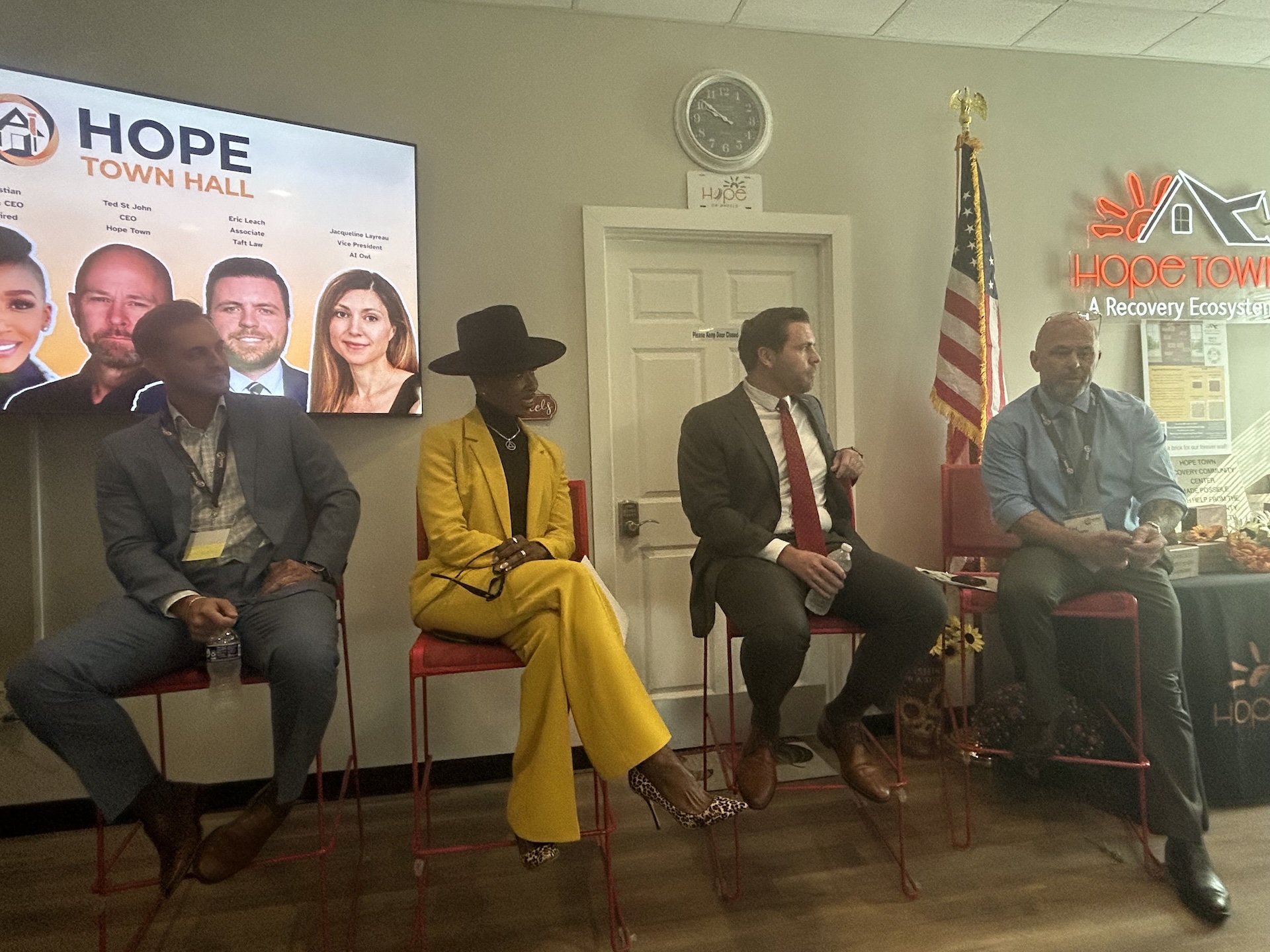
Hope Town Ohio has fully embraced the use Artificial Intelligence technology to assist individuals recovering from substance abuse and mental health disorders. The local social services organization hosted an AI Town Hall Summit to discuss AI’s positive impact on behavioral health last Thursday morning at 9621 East Center Street in Windham.
“We have people coming in from across the state, we have people coming from across the country, all leaders in the workforce of behavioral health and recovery space to have very big and important conversations on the guardrails we need to have on AI,” Hope Town Ohio Administrative Coordinator Zoey St. John told The Weekly Villager.
The highlight of the event was a discussion by a panel of experts, consisting of Hope Town Ohio CEO Ted St. John, Founder & CEO of Life Inspired Nyla Christian, CEO of AI OWL Cas Maxwell and Regulatory Attorney at Taft Law Eric Leach.
According to St. John, the goal of AI is to solve complex problems and figure out its capabilities.
The panel fielded often-asked questions for half an hour then took questions from the audience.
CEO of Stealth Startup Tyler Kohrt asked the panel questions about how AI effects the behavioral health of the general workforce.
Kohrt’s first question was what is the real value of AI?
St. John responded by saying that most of the panel experts spent the first year learning how to implement AI and have now figured out its capabilities.
Christian replied that the unique thing about recovery advocacy is the people, as approximately 23.5 million people are in recovery but almost 44 million people who need it are not, which presents an opportunity for AI to expand its reach.
Leach acknowledged that AI has not resulted in a reduction of the workforce but provided an opportunity for aspiring employees to close the experience gaps.
Maxwell said that another opportunity was to capture lost knowledge when long term employees retire and their historical knowledge is lost
Kohrt asked the panel what was the importance of automating human needs and what needed to be addressed?
Leach responded with a question of his own, what tasks could be addressed by AI?
Christian replied by addressing the optimism and pessimism of AI’s involvement with human connection, but that AI could save a lot of time for people
Maxwell acknowledged that there were certain tasks that they did not want to allow AI to be responsible for, including critical judgement and accountability.
“AI has a governance, it doesn’t make decisions on housing, treatment of transportation,” added St. John.
St. John conceded that once AI started to perform essential tasks such the ones he listed, trust would begin to erode.
Leach said that in terms of the internal work force, relying too much on AI resulted in liability issues.
Kohrt’s next inquiry was how could AI engage the 14 million people in recovery who already were members of the general workforce or attempting to join it?
Leach said that the objective was to engage the public work force system, as the biggest thing would be partnering with employers to use AI to adequately train aspiring or current workers.
“Folks in recovery believe we are not a risk and can demonstrate abilities clearly,” replied St. John.
He spoke of the National Capsule Project, which assists people in recovery to unlearn and relearn the needed responsibilities of any potential job.
Christian said that potential employees need to become recovery certified, which includes teaching employers that there is an untapped workforce out there.
Maxell said that the general question of the current workforce was how AI applied to that individual’s job and how it could assist in day-to-day operations. His response was that AI could assist in employee training.
“We have several local boards that are doing AI matching pilots, looking at better ways to make better holistic matches,” he added.
Kohrt asked the panel what legal and ethical resources would be at organizations’ disposal and what should they be cognizant of?
“Don’t run before you crawl,” answered Leach. “Create a governance process.”
St John described this area as an important space, as organizations needed to be strategic when creating governance policies for AI.
He added there were a lot of rules when it came to regulating AI.
Maxwell said that organizations needed to make AI tool agnostic and focus on setting boundaries. He noted that there would be experimental phases and new policies could be created on the fly.
Kohrt’s last question was in one year, what did each of the panel experts hope that people experience differently because of AI?
St. John responded by saying that he hoped there would be less repetition and that everyone could do better with making systems operational and providing guardrails to protect data.
Maxwell said that he was optimistic that employers would realize that they could achieve more with the same amount of people.
Leach replied that technology was here to stay so he hoped to see a deeper integration across economic sectors.
Christian said that her vision was to triple the number of people in recovery and that more AI experts would become prominent, the way St. John had immersed himself in the AI industry, and that AI could strengthen their reach.
The day continued to revolve around what AI could to improve organizations, with Hope Town Ohio being a prime example.
“A lot of what we stress is that it gives people more time to focus on what they enjoy doing,” Hope Town Ohio automative coordinator Gavin Kohn told The Weekly Villager. “Here at Hope Town Ohio, it would be a case of just repurposing a monotonous job a person had into something more meaningful for them.”